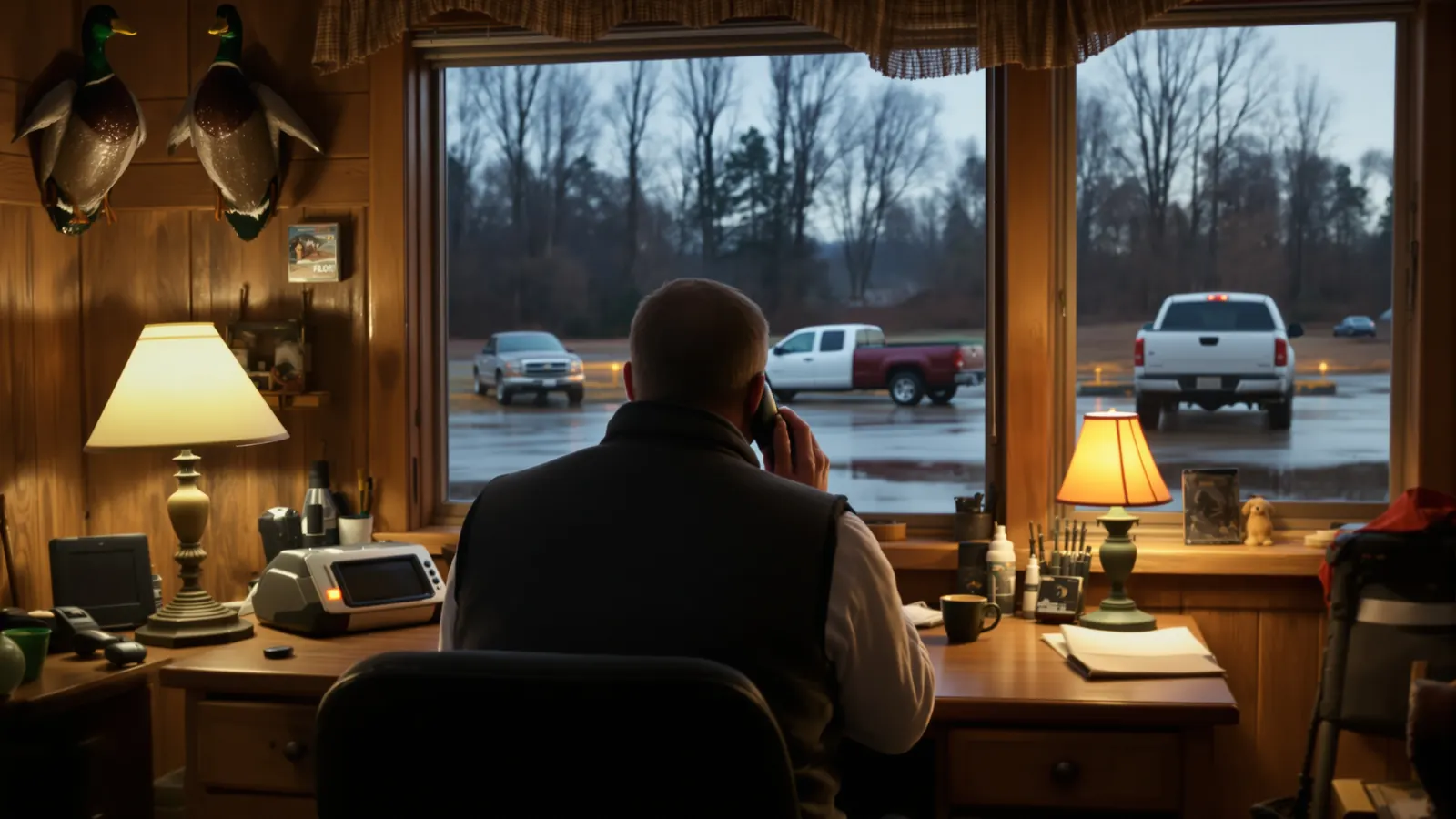
Reply calmly, fix the cause, move on
How to Respond to Negative Reviews When You Run an Outfit or a Charter
A reply framework and sample responses for the complaints outfitters and captains actually get: no birds, bad weather, a short-tempered guide, deposit disputes, and reviews that break Google's rules.
Knowing how to respond to negative reviews matters more for an outfitter than for most small businesses, because hunters and anglers read reviews closely before they send a deposit for a trip months away. A one-star review about an empty sky or a grumpy guide sits on your profile next to every good one, and the reply underneath it is often read more carefully than the complaint.
The reply is not written for the unhappy client. It is written for the next hundred people deciding whether to book. This guide gives you a framework, sample replies for the complaints that actually come up in this business, the cases where flagging the review is the right move, and what to change in camp so the same complaint does not come back next season.
Short answer
Reply within a few days, calmly and briefly. Thank the reviewer, acknowledge the specific problem, add facts without arguing, say what you changed or offered, and invite them to call you directly. Never share private client details, never blame the hunter, and flag only reviews that break Google's content policies.
Before you type a reply
The worst replies are written the same night the review shows up, after a long day in the field, by someone who feels personally attacked. Give it a few hours, then do three things first.
- Find the booking. Confirm the person actually hunted or fished with you, which date, which guide, which package. Look at the payment history and any messages before and after the trip.
- Talk to the guide or captain. Get their account while it is fresh. Ask what the weather and the birds or fish were doing, and if anything happened in camp.
- Separate fact from feeling. "We saw no ducks" might be literally true. "The guide didn't care" is how it felt to the client. Both deserve a response, but in different ways.
Also decide who will reply. The owner usually should. A guide replying to criticism of himself rarely goes well.
When the review is simply right
Sometimes the facts check out and the client has a point: the guide showed up late, the boat broke down at the dock, the cook forgot the hunter with the food allergy. Say so plainly. A reply that owns a real mistake ("You're right, we were late picking you up, and that's on us") does more for the next reader than any explanation. Then say what has changed, and only promise changes you have actually made.
A five-part framework for every reply
Almost every good response to criticism follows the same order. Learn the order and you can write any reply in a few minutes.
| Part | What it does | Example line |
|---|---|---|
| Thank | Shows you read it and are not defensive | "Thanks for taking the time to write this." |
| Acknowledge | Names the specific problem in their words | "You're right that the birds didn't work on Saturday." |
| Context | Adds facts readers need, without arguing | "A warm front pushed most of the ducks north that week." |
| Action | Shows what changed or what you offered | "We've since added a second field for days like that." |
| Door open | Moves the conversation off the review | "Please call the lodge directly; we want to talk it through." |
Once you know how to respond to negative reviews in this order, the hard part is restraint. Keep the whole thing short, often four to six sentences. A long reply reads as a defense brief. Sign it with a name and role ("Owner" or "Captain") so it sounds like a person.
Google's own guidance notes that the person who wrote the review is notified when you reply, that replies are checked against Google's content policies before posting, and that customers can still change their review after reading your reply. See Google's help page on reading and replying to reviews. That last point is the real goal: a fair reply sometimes earns an updated review.
How to respond to negative reviews about the usual complaints
The examples below are starting points. Replace the details with what actually happened, and never copy one word for word into several replies; readers notice.
"We didn't see a single deer / duck / fish"
This is the most common complaint in the business, and the reply should never say "that's hunting." Explain what you did about it.
"Thanks for the honest review. You're right, Saturday was slow; the warm front that weekend pushed birds off our fields and we moved you to the backup blind by mid-morning. We know a quiet morning is a long one when you've driven six hours. We'd like to get you back out in a better week. Please give the lodge a call."
"The weather was terrible and they still took our money"
"We're sorry the trip wasn't what you hoped. We run trips in normal seasonal weather, and our policy explains how weather calls work, but we understand that a cold, rainy day on the water is disappointing. If anything about the call to go out felt unclear, we want to hear about it directly."
"The guide had a bad attitude"
Do not defend the guide in public, and do not throw them under the bus either.
"Thank you for telling us. How our guides treat hunters matters to us, and the owner has spoken with the team about your hunt. We'd appreciate a call so we can hear the details from you."
"They wouldn't refund the deposit"
"We understand the frustration. Our deposit terms are shown at booking, and we apply them the same way for every hunter so we can hold dates for everyone. We did offer to move your deposit to another date this season, and that offer stands. Please reach out any time."
"Way too expensive for what we got"
Price complaints are really about expectations. Restate what the trip includes, without sounding like a sales page.
"Thanks for the feedback. Our three-day package includes lodging, meals, a guide for every two hunters and bird cleaning, and we list all of that on the hunt page so the price is clear up front. We're sorry it didn't feel worth it this time, and we'd like to hear what would have made the difference."
"The captain didn't put us on fish and half of us got seasick"
"We're sorry the day was rough. Conditions offshore built faster than forecast, and the captain chose to fish closer in where it was safer, which meant fewer bites. We know that's a long, uncomfortable day. Please call the office; we'd like to talk about getting you back out on a calmer morning."
"The lodge / food / boat was not as advertised"
"Thanks for the feedback on the lodge. You're right that the heat was out in one cabin that weekend; it's been repaired. We'd like to make it right, so please contact us directly."
When to take it offline, and what that really means
"Please contact us" at the end of a reply is not a brush-off if you actually follow through. Take the conversation off the public page when:
- Money is involved (refunds, deposits, credits).
- The complaint involves a safety incident, an injury or a firearm.
- The client's account depends on private details (their health, a family member, a license issue).
- The reviewer is clearly upset, and a public back-and-forth would escalate it.
Then contact them yourself: call or email from the booking record. If you resolve it, you can thank them publicly in a short follow-up line, but never ask them to remove or change the review as a condition of a refund or credit. Offering something in exchange for changing a review is the wrong trade, and it tends to surface later.
If the issue involves an injury or anything that could become a legal claim, talk to your insurer or attorney before you reply publicly. A short, neutral reply ("We've reached out to you directly") is enough.
Follow-through is what makes this work. Make the call within a day or two of posting the reply, note what was offered in the booking record, and send a short written summary afterward so there is no confusion later about what was agreed.
Reviews that break Google's rules
Some negative reviews should not be answered first. They should be reported. Google only removes reviews that violate its policies, and its help page is direct about it: do not report a review just because you disagree with it. Google also does not mediate disputes between businesses and customers.
Google's prohibited and restricted content policy lists categories such as fake engagement, rating manipulation, impersonation, harassment, personal information, obscenity and profanity, and off-topic content. A review posted by someone with a conflict of interest, or a rant about something unrelated to your business, may fall under those. A review from a hunter who did come to camp and simply had a bad time is not a policy violation, however unfair it feels.
How to report
- Open your Business Profile, select Read reviews, and use the report option next to the review, choosing the reason.
- Or use Google's Reviews Management Tool to report and then check the status.
- If Google finds no violation, the tool offers a one-time appeal.
Google explains the process on its report inappropriate reviews help page. While a report is pending, a calm reply is still usually wise: "We have no record of a booking under this name. If you hunted with us, please call so we can look into it."

What never to say in a public reply
- Private details. Part of learning how to respond to negative reviews is learning what stays out of them. The client's harvest, health, license status, what they paid, who they came with. Your reply is public forever.
- Blame. "You couldn't hit anything" or "you showed up late and hungover" may be true. It will still cost you more bookings than the review did.
- Threats. Mentions of lawyers, defamation or "we'll be posting your behavior" belong nowhere near a review.
- Offers tied to removal. Never offer a refund, credit or free day in exchange for deleting or editing a review.
- Canned apologies. The same paragraph under every bad review looks like nobody read them.
- Arguments about the star count. "We don't think this deserves one star" convinces no one.
Also check your own booking terms. The FTC explains that the Consumer Review Fairness Act makes it illegal to use form contract terms that bar or restrict people from reviewing a business, impose a penalty or fee on someone who posts a review, or require people to give up intellectual property rights in their review content. Read the FTC's Consumer Review Fairness Act guidance for businesses, and remove any "no negative review" clause an old template may have left in your waiver or terms.
How to respond to negative reviews as a team
An outfit with three camps and a dozen guides needs a simple rule so reviews do not sit unanswered for a month or get three different replies.
- One owner of replies. Usually the owner or office manager. Guides and captains flag reviews to that person; they do not reply themselves.
- A response window. Aim to reply within a few days. Fast enough to show you care, slow enough to check the facts.
- A second read for the hard ones. Any reply to a one-star review gets read by one other person before it posts.
- Reply to the good ones too. A short, specific thank-you under positive reviews shows the replies are written by a person, which makes your response to a bad one more believable.
If replying to reviews keeps slipping to the bottom of the list in season, it is a reasonable task to hand off. The HuntReserve marketing team handles review generation and Google Business Profile work as part of the Full Draw package.
How to respond to negative reviews by fixing the cause
The best long-term answer to a bad review is not the reply. It is making sure the next hunter does not have the same experience. Keep a simple log of every complaint, then look for patterns at the end of each season.
| Repeated complaint | Possible fix in camp |
|---|---|
| "Didn't know what to bring" | Send a what-to-bring reminder a few days before every hunt |
| "Surprised by the final bill" | Show add-ons and the total at booking; invoice the balance before the hunt |
| "Hunt felt rushed or disorganized" | Day-before message with meeting time, place and the plan |
| "Guide was rude or disengaged" | Guide training, fewer back-to-back days, owner check-ins |
| "Nobody told us about the weather call" | Decide the night before and message every hunter |
| "Never heard back about the processing" | Status updates on meat, hides and mounts |
HuntReserve sends automatic reminders for balances, missing paperwork, what to bring and the day before, and its processing tracker gives hunters a status page with text and email updates on meat, hides and mounts.
After the hunt it sends a review request: hunters rate the trip and upload photos, and are invited to review you on Google. Those post-hunt ratings also give you an early warning before a complaint lands in public. See the full feature list, or how it works for hunting outfitters. For building review volume in the first place, read how to get more Google reviews and our guide to Google Business Profile optimization. When you want help with both, get started.
Frequently asked questions
Should an outfitter reply to every negative review?
Yes, in almost every case. Readers deciding whether to book look at how you handle criticism as closely as the complaint itself. The exceptions are reviews that clearly break Google's policies, which you should report first, and reviews tied to an injury or possible legal claim, where a short neutral reply and a call to your insurer or attorney come first.
How long should a reply to a bad review be?
Short. Four to six sentences usually covers thanks, acknowledgment, context, what you changed, and an invitation to call. Long replies read as defensive and tend to repeat the complaint. If the issue needs more detail, move it to a phone call or email with the client.
Can Google remove a negative review that is unfair?
Only if it violates Google's content policies, for example fake engagement, rating manipulation, off-topic content, harassment or personal information. Google says not to report a review just because you disagree with it, and it does not mediate disputes. If a report is rejected, the Reviews Management Tool allows a one-time appeal.
Can an outfitter offer a refund if the client removes the review?
Do not tie any refund, credit or free trip to removing or changing a review. Resolve the complaint on its merits. If the client later chooses to update the review, that is their decision. Also check your booking terms for any clause restricting reviews, which the FTC says the Consumer Review Fairness Act prohibits in form contracts.
What if the reviewer never hunted with us?
Search your booking records under their name and any variations. If there is no record, report the review to Google as a policy violation and post a calm reply such as: we have no booking under this name; if you hunted with us, please call so we can look into it. Avoid accusing the reviewer of lying.
Sources
- Google Business Profile Help: Read and reply to reviews
- Google Business Profile Help: Report inappropriate reviews
- Google Maps user contributed content policy: prohibited and restricted content
- FTC: Consumer Review Fairness Act, What Businesses Need to Know
Rules, fees and policies change. This guide was checked against the official sources above in October 2026. It is general information, not legal, tax or insurance advice: confirm the current details with the agency or a licensed professional before you rely on them.
Keep reading
More from the HuntReserve blog
How to Get More Google Reviews for Your Outfit, the Right Way
Reviews come from a habit, not a campaign: ask every guest at the right moment, make it a two-tap job, keep staff on script and stay well inside Google's rules on incentives and selective asking.
12 min read
Google Business Profile Optimization for Outfitters, Lodges and Charters
A field guide to setting up a Google profile for a hunting outfit, lodge or fishing charter, with Google's own rules on names, service areas, seasonal hours, booking links and reviews.
12 min read
How to Write a Cancellation Policy for Guided Hunts and Fishing Charters
Time-based tiers, weather calls, medical emergencies, transfers and rebooking, with sample wording for a duck camp, an offshore charter and a draw-dependent elk hunt.
12 min readSpend the season in the field.
Let HuntReserve run the office.
Tell us about your outfit. We'll call you, walk you through it with your own hunts and get you set up.