Home / Blog / Running your outfit
Plan the worst day before opening day
Emergency Action Plan for Hunting Camps, Lodges and Fishing Charters
Roles, communication with no cell signal, evacuation routes, trauma center planning, scenario cards for tree stand falls, lightning and man overboard, plus drills that fit a real hunting schedule.
An emergency action plan is the written answer to a question every outfitter hopes never to face: a hunter is hurt, two miles from the truck, with one bar of signal that comes and goes. Who does what, in what order, and how does help find you?
Camps and charter boats run in places where response times are long and conditions change fast. A plan you have already walked through turns panic into a checklist. Below is a practical build, starting with the OSHA framework and ending with scenario cards your guides can carry.
Short answer
An emergency action plan lists how to report an emergency, who leads, how to evacuate and account for everyone, who gives first aid and who to contact. For a hunting camp or charter, add no-signal communication, written locations for every stand or fishing spot, routes to the nearest hospital, scenario cards and regular drills.
What OSHA's emergency action plan rule actually says
The federal standard most people mean is 29 CFR 1910.38. It is worth reading because its structure is a good skeleton even for operations that are not sure the rule applies to them. Per OSHA's emergency action plan standard, an employer must have a plan whenever another OSHA standard requires one. The plan must be in writing, kept in the workplace and available to employees, although an employer with 10 or fewer employees may communicate the plan orally.
At a minimum, the standard lists six elements:
- Procedures for reporting a fire or other emergency.
- Procedures for emergency evacuation, including type of evacuation and exit route assignments.
- Procedures for employees who stay behind to operate critical operations before they evacuate.
- Procedures to account for all employees after evacuation.
- Procedures for employees performing rescue or medical duties.
- The name or job title of every person employees can contact for more information about the plan.
The same section requires an employee alarm system, training for the people who help others evacuate, and a review of the plan with each employee when the plan is created, when they are first assigned, when their duties change and when the plan changes. Coverage for your specific outfit depends on your staffing and the other standards that apply, so confirm with OSHA or an attorney. Either way, those elements are the right starting list.
Translating the standard to a camp, lodge or boat
OSHA wrote the rule with buildings and factories in mind. A hunting operation needs the same ideas adapted to fields, timber, marsh and open water. Here is how each element maps to real camp work.
| OSHA element | What it looks like at a hunting camp | What it looks like on a charter boat |
|---|---|---|
| Reporting an emergency | Who calls 911, from where, and the exact words and location they give | Who radios for help, who calls, and the vessel position read from the plotter |
| Evacuation | Routes from each blind, stand and field to a road an ambulance can reach | The nearest safe landing, marina or meeting point with EMS for each fishing area |
| Critical operations | Securing firearms, kenneling dogs, shutting down a lodge generator or kitchen | Securing lines, gear and the engine before transferring a patient |
| Accounting for people | A head count of hunters and guides at a set rally point | A passenger count against the manifest |
| Rescue and medical duties | The guides trained in first aid and what kit they carry | The crew member assigned to the patient while the captain runs the boat |
| Contact person | The camp manager or owner, by name, with a backup | The owner or shore contact who tracks the trip |
Keep the language plain. A good plan is short enough that a new guide can read it on day one and remember the important parts under stress.
Write one emergency action plan per operating location rather than one for the whole business. A lodge with a bird field, a lease two counties away and a boat on the river has three different sets of routes, hospitals and dead zones. The roles and scenario cards can stay the same; the maps and contacts change with the ground.
Communication when there is no cell signal
Most hunting emergencies go wrong in the first ten minutes because nobody can reach help or nobody knows where to send it. Fix this part of your emergency action plan first.
Know your dead zones
Before the season, walk or drive the property with each guide's phone and mark where calls connect and where they drop. Note the closest reliable signal spot to every blind and stand. On the water, note where coverage fades along your usual runs. That knowledge is worth more than any gadget.
Carry a backup that does not depend on towers
Satellite messengers, satellite phones and two-way radios all have a place. On boats, a marine radio is the standard way to reach other vessels and rescuers. Whatever you choose, test it before the season and make sure every guide knows how to use it with cold hands in the dark.
Voice first, text as a fallback
The FCC advises callers to always contact 911 by making a voice call if you can. Text to 911 is only available in certain locations, and if you text where it is not supported, carriers must send an automatic bounce-back message telling you to use another method. Do not plan around texting unless you have confirmed that your county accepts it.
Give every location a written address
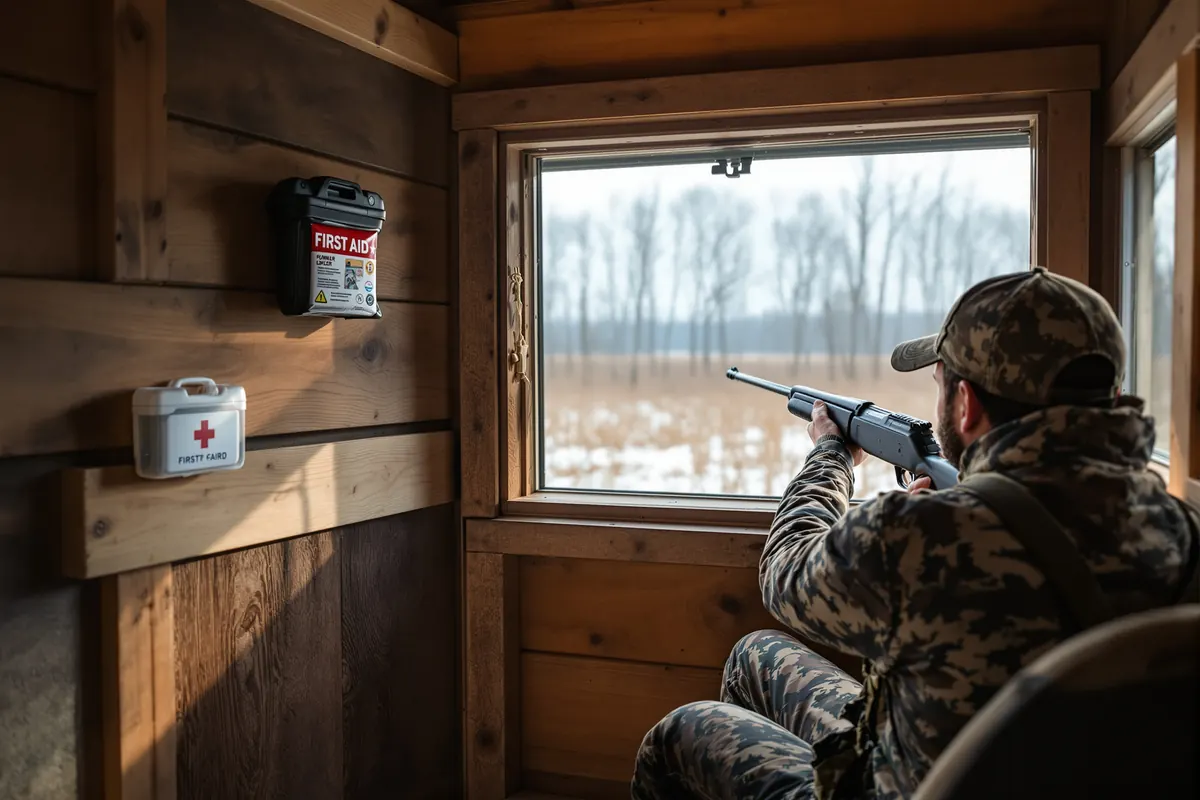
Print a location card for each blind, stand, pit and dock: GPS coordinates, the nearest road and gate, the gate code, and a landmark an ambulance crew can find. Put the card inside the blind and in every truck. A caller reading a card is far faster than a caller guessing.
Routes, rally points and the nearest trauma center
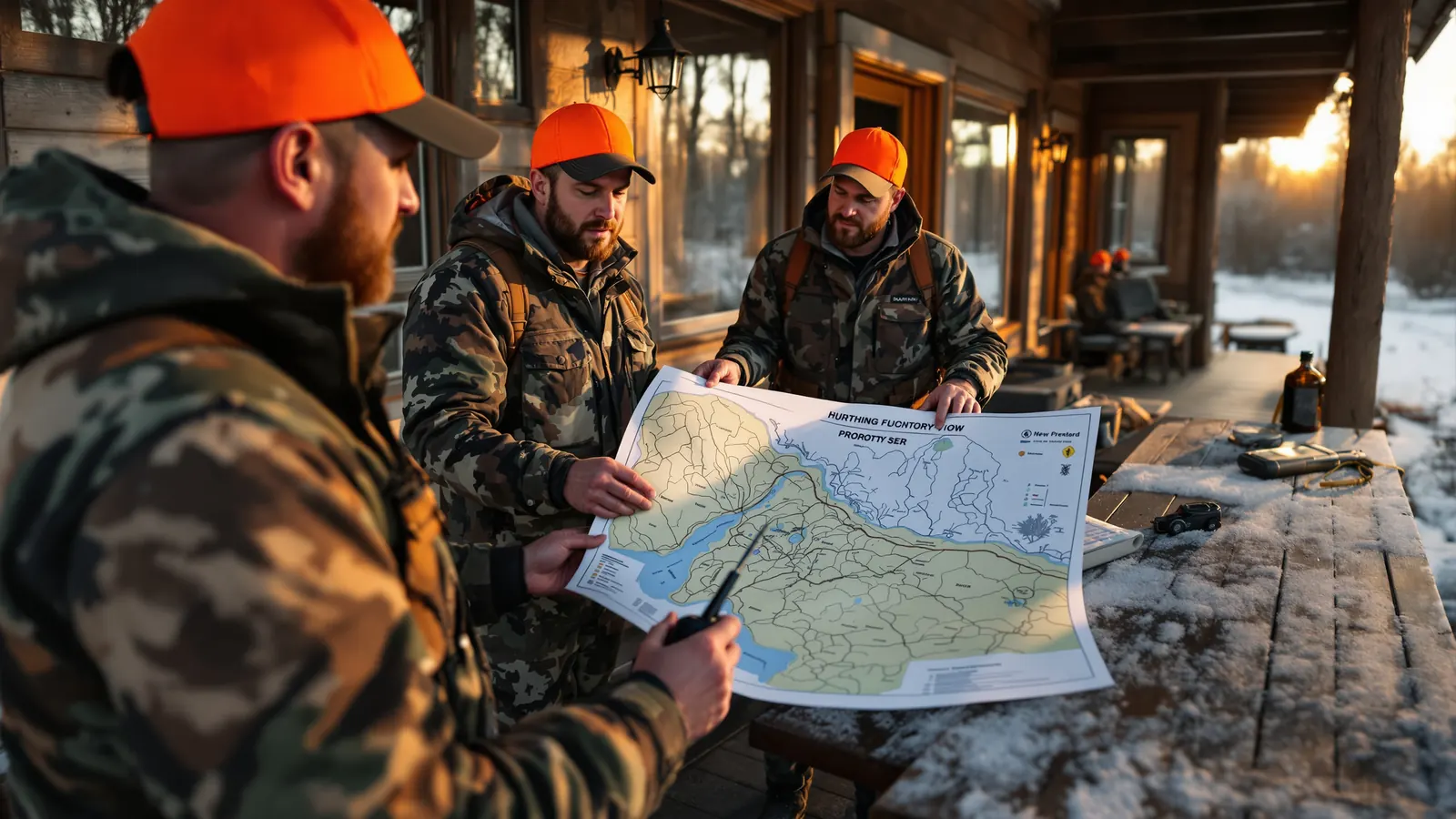
The evacuation section of an emergency action plan for a property-based outfit is really a set of short maps.
- Extraction routes. For each hunting area, mark the fastest route to a road where an ambulance can turn around, plus a second route for when a creek floods or a field is too wet to drive.
- EMS meeting points. Choose a gate, crossroads or boat ramp where a guide will meet responders and lead them in. Rural crews lose valuable time hunting for unmarked farm roads.
- Rally points. Pick a place where everyone gathers for a head count when you pull people out of the field, such as for lightning or a lost hunter.
- Hospitals. Identify the nearest emergency room and the nearest trauma center, which may be different hospitals. Call them or talk with your county EMS to confirm what each one handles, rather than assuming.
- Air transport. Ask local EMS how medical helicopters are requested in your area and whether there are landing spots on or near your property they would use.
- Keys and gates. Decide where truck keys live during a hunt and who holds the gate keys. A locked gate can cost more time than the drive.
If you guide on public land or someone else's lease, build a lighter emergency action plan for each area anyway: the access points, the nearest road an ambulance can reach and the closest hospital. It takes an evening with a map and pays off the first time you need it.
Walk these routes with the whole crew before opening day. New guides should drive each one at least once in daylight.
Scenario cards for the emergencies camps actually face
A general plan is not enough. Write a one-page card for each likely scenario, built around first steps, who calls, and where help meets you. Your first aid training provider, local EMS and your insurer can help you get the medical steps right. A few scenarios every outdoor operation should cover in its emergency action plan:
Firearm injury
Make the scene safe first: unload and secure every gun in the area. Then call for help with the exact location card, start the care your crew is trained to give, and send a guide to meet responders at the road.
Tree stand fall
Falls from stands can involve spinal injuries, so the card should say not to move the hunter unless there is an immediate danger. Include how to reach the stand by vehicle and how to lower a hunter left hanging in a harness.
Cardiac or sudden medical emergency
Many hunters are older and walking harder than they do at home. Know who on staff is trained in CPR, where any defibrillator is kept, and how long it takes to reach the lodge from each field.
Heat and cold
Early dove and teal seasons bring heat illness; late duck and deer seasons bring hypothermia, especially after a fall into water. Write down warning signs to watch for, where shade or a heated vehicle is, and when to stop the hunt.
Lightning
The National Weather Service is blunt: there is no safe place outside when thunderstorms are in the area, and its rule is "When Thunder Roars, Go Indoors." Your card should name the shelter for each area (a hard-topped vehicle or building) and who makes the call to pull everyone in.
Drowning and man overboard
For boats and flooded timber, the card covers who keeps eyes on the person in the water, how the boat approaches, how you get someone back aboard and when you call for help.
Lost hunter
Set a check-in time for every hunter. If someone misses it, the card spells out how long you search with your own crew before calling the sheriff or search and rescue.
Roles: who does what in the first ten minutes
Every emergency action plan needs names next to jobs. In a small camp one person may hold two roles; that is fine as long as it is decided ahead of time.
- Incident lead. Usually the senior guide on scene. Makes the decisions and keeps everyone else on task.
- Caller. Moves to signal if needed, calls 911 and reads the location card. Stays on the line.
- Care provider. The trained person who stays with the patient and gives first aid within their training.
- Runner. Drives to the EMS meeting point, opens gates and leads responders in.
- Accountability. Gathers the rest of the party at the rally point, counts heads and secures firearms and dogs.
- Base contact. The owner or manager at the lodge or dock who calls family, coordinates other hunts and starts the written record.
On a charter boat the captain is almost always the incident lead and the person running the boat, so the mate typically takes the care role. Write that down rather than leaving it to instinct.
Drills that do not wreck a hunting morning
A plan nobody has practiced tends to fall apart under pressure. You do not need full-scale exercises; short, regular practice works better.
- Preseason tabletop. Sit the crew around a map and talk through two scenarios step by step. Ask each guide what they would do and where they would go.
- Route drive. Have each guide drive from their assigned blinds to the EMS meeting point and the hospital. Time it.
- Communication check. Test every radio and satellite device at the start of the season and after any repair.
- Dock drills. Before the first charter of the year, practice a person-in-the-water recovery with crew only.
- New-hire walkthrough. Anyone joining mid-season gets the plan, the cards and one route drive before guiding alone.
Pair the drills with a strong pre-hunt talk to clients. Our post on running a safety briefing covers what hunters and anglers need to hear before they head out.
Documenting your emergency action plan and every incident
Paperwork is not the point of an emergency action plan, but records help you improve it and protect the business afterward.
- Keep the full plan in the lodge or office, a summary binder in each truck, and a waterproof copy on each boat.
- Date every version and note what changed, so you can show when guides were briefed.
- After any incident or near miss, write down what happened, the times, who did what and what you would change.
- Review the plan at the start of each season and after any change in property, staff or hunt types.
Two things a plan does not replace: insurance and signed waivers. Talk with your agent about what your policies expect from you in an emergency (see our overview of outfitter insurance), and keep your hunting liability waiver current. This is general information, so confirm legal and insurance questions with an attorney or licensed agent.
Building the plan into daily operations
The best emergency plans live inside the daily routine instead of a binder nobody opens. A few HuntReserve tools support that.
- Property maps. Mark fields, blinds and stands on your property maps so the location for every hunter on every morning is already known.
- Field conditions. Hourly and 16-day forecasts, wind, pressure trend and sunrise and sunset help you make the weather call early.
- Check-In Board. See who has registered, signed the waiver and been approved before anyone goes to the field.
- Camp Mode. Waivers and license photos are captured on a tablet with no signal and sync later, so paperwork never pushes a guide toward the one spot with coverage.
- Messages and Camp Chat. Keep the crew on one channel when the plan changes.
Browse the full set on our features page, see how it fits property-based outfits on the hunting outfitter software page, or look at the fishing charter software page for boats. When you are ready, talk to us about your outfit.
Frequently asked questions
Is a hunting outfitter legally required to have an emergency action plan?
OSHA's rule requires one when another OSHA standard calls for it, and it applies to employers, so the answer depends on your staffing and the work you do. State rules, land agencies and insurers may add their own expectations. Even when nothing requires it, a written plan is a basic safety practice. Confirm your obligations with OSHA or an attorney.
How often should a camp review its plan?
At minimum, review it before each season and walk new guides through it before they work alone. OSHA's standard also calls for a review when an employee's duties change and whenever the plan changes. Any incident or near miss is another good trigger to sit down and update the cards.
What should go on the emergency card inside each blind or stand?
Include GPS coordinates, the nearest road and gate, any gate code, a landmark responders can find, the nearest spot with reliable cell signal, the EMS meeting point and the numbers to call. Keep it short and waterproof so a stressed hunter or guide can read it aloud to a dispatcher.
Does a signed liability waiver replace an emergency plan?
No. A waiver deals with legal risk after something happens; an emergency plan deals with getting help to someone right now. They serve different purposes and you need both. Ask an attorney about your waiver and an insurance agent about what your policies expect of you in an emergency.
What is the best way to call for help if there is no cell service at camp?
Know where signal exists before you need it, and carry a backup that does not depend on cell towers, such as a satellite messenger, satellite phone or radio. On the water, a marine radio is standard. Test every device each season, and keep voice calls to 911 as the first choice whenever a call will connect.
Sources
- OSHA 29 CFR 1910.38, Emergency action plans
- FCC consumer guide: Text to 911
- National Weather Service: Lightning Safety
Rules, fees and policies change. This guide was checked against the official sources above in October 2026. It is general information, not legal, tax or insurance advice: confirm the current details with the agency or a licensed professional before you rely on them.
Keep reading
More from the HuntReserve blog
How to Run a Pre-Hunt Safety Briefing Your Hunters Will Remember
A field-tested structure for the talk before every guided hunt or trip: guns, shooting lanes, stands, boats, dogs, weather and what to do if something goes wrong.
12 min read
Outfitter Insurance: The Coverages a Guide Service Actually Needs
A plain breakdown of the policies a hunting outfit carries, from general liability to horses, trucks, lodges and guides, plus what federal land permits require and what underwriters will ask you.
13 min read
Hunting Liability Waiver: What Yours Should Cover, Clause by Clause
The hunting specific risks, clauses and signing habits that belong in an outfitter's waiver, from tree stands and firearms to minors, guardians, medical consent and how state law can change the picture.
12 min readSpend the season in the field.
Let HuntReserve run the office.
Tell us about your outfit. We'll call you, walk you through it with your own hunts and get you set up.